
Electrolytic nickel plating
What is electroless nickel plating?
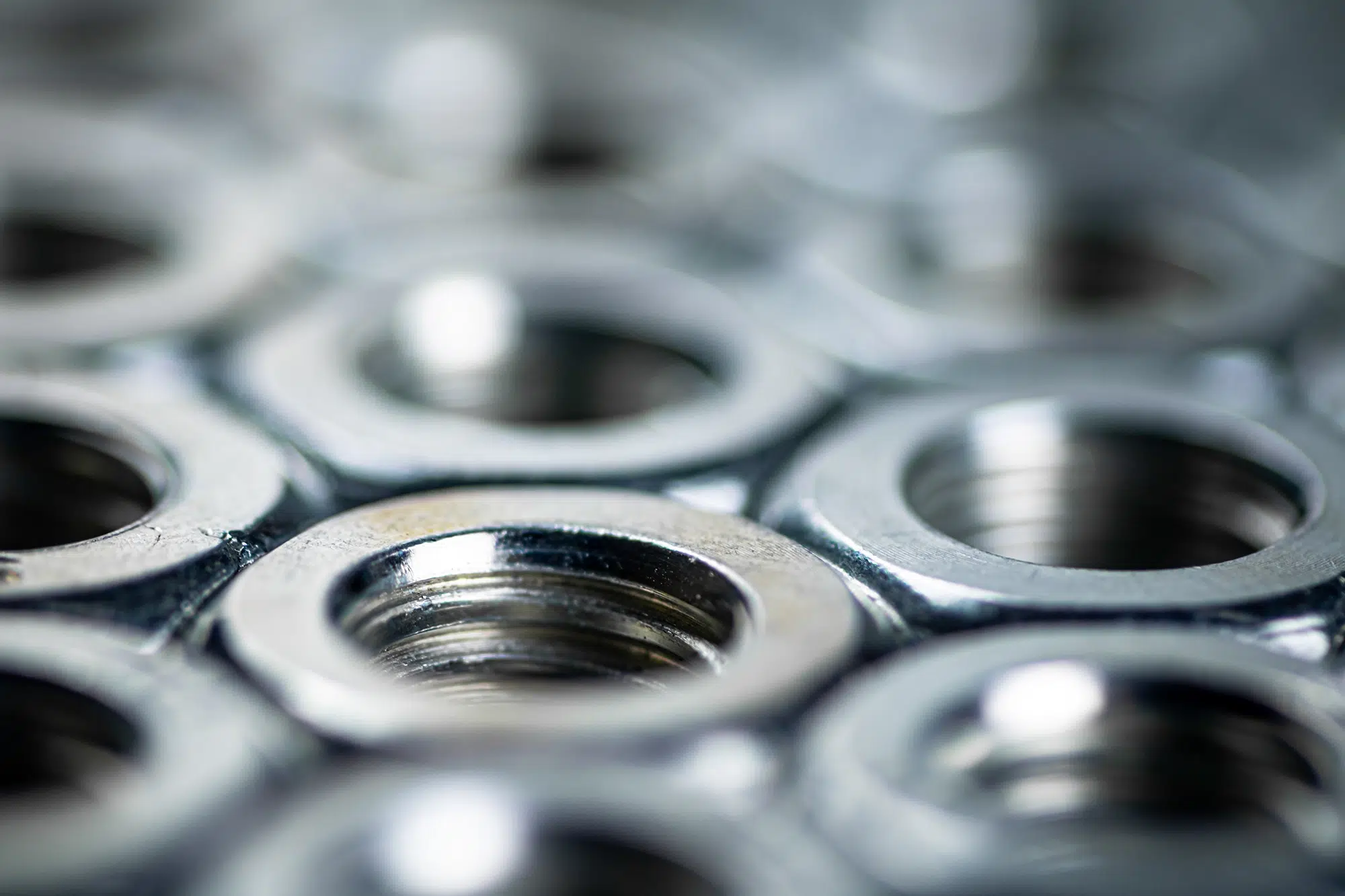
Chemical nickel plating is a metal surface treatment process that involves depositing a thin layer of nickel onto a metal part (steel, aluminum, etc.). This nickel-phosphorus alloy is produced through a chemical process involving immersion in an aqueous bath. It imparts new properties to the treated surfaces and is used in particular to improve the corrosion resistance and wear resistance of metal parts.
Unlike electrolytic processes, chemical nickel plating producesa perfectly uniform deposit, regardless of the part’s shape, without any excess thickness on edges or protruding areas.
This process is particularly well-suited for complex parts or those with variable geometries, as it ensures uniform coverage, even in hard-to-reach areas. It generally does not require any additional finishing after treatment and maintains the part’s dimensional tolerances.
- Automotive and Transportation
- Aerospace
- Oil, Chemical, and Energy Industries
- Electronics and Electrical Engineering
- Medical and Precision Manufacturing
All subjects
Electrolytic nickel plating is compatible with a wide variety of materials, providing long-lasting protection against corrosion and wear while improving surface properties.


A crucial process for the industry
Corrosion protection
Electrolytic nickel plating creates a highly durable coating that protects against moisture and minimizes oxidation. It is therefore ideal for harsh environments such as industrial, marine, or chemical applications.
Uniform layer thickness
Nickel is deposited evenly, even in hard-to-reach areas and inside cavities on complex shapes. As a result, we achieve a consistent thickness throughout, with no excess or thin spots.
Aesthetic finishes
This process delivers a uniform, high-quality finish with a clean, consistent appearance across the entire surface. It is available in several finishes (glossy, satin, or matte) while faithfully preserving the piece’s details.
Wear resistance
Depending on the treatment (particularly after heat treatment), we obtain a very hard surface that is abrasion-resistant and long-lasting, making it ideal for moving mechanical parts.
The steps in the electroless nickel plating process
To ensure optimal results, electroless nickel plating relies on a rigorous and structured process.
Surface preparation
The process begins with careful preparation of the part. This step involves removing all surface contaminants, such as grease, oil, or dust, using a suitable degreasing agent. The part is then rinsed with water and subjected to acid etching to remove oxides and other residues. This phase is essential, as it directly affects the quality and adhesion of the nickel deposit.
Surface activation
Once clean, the surface must be activated to make it chemically receptive to the coating. This activation is typically performed using specific solutions, often acidic, which make the surface more reactive. This step is particularly important for certain materials, such as aluminum or stainless steel, which require special preparation to allow the nickel to adhere.
Immersion in the electroless nickel plating bath
The part is then immersed in a bath containing nickel salts and a reducing agent, typically sodium hypophosphite. Unlike electrolytic nickel plating, no electric current is used. The nickel deposit forms through a chemical reaction that occurs directly on the surface of the part, ensuring an even distribution across the entire surface.
Deposit growth
Once the reaction has begun, nickel deposition proceeds autocatalytically, meaning it continues on its own as long as the part remains in the bath. The thickness of the coating depends on the immersion time and can be precisely controlled. This process produces a uniform coating, even on complex geometries or hard-to-reach areas.
Rinsing
After the plating process, the part is thoroughly rinsed to remove all chemical residues from the bath. This step helps prevent any subsequent contamination or undesirable reactions and helps ensure the final quality of the treatment.
Quality Control
Finally, the part undergoes various inspections to verify that the coating meets specifications. This includes measuring the coating thickness, assessing its adhesion, and inspecting its visual appearance. Corrosion resistance tests may also be conducted to ensure that the coating meets performance expectations.
The different types of electroless nickel plating
At Wipelec, electroless nickel plating is available in three main variants: low-phosphorus nickel (FP), medium-phosphorus nickel (MP), and high-phosphorus nickel (HP).
Low phosphorus (2–5%)
- Very hard coating, good wear resistance
- More limited corrosion resistance
- Used for mechanical parts and tools
Moderate phosphorus content (6–9%)
- Balancing protection against hardness and corrosion
- Very versatile
- Used in general engineering
High phosphorus (10–13% and higher)
- Excellent corrosion resistance
- Often amorphous structure
- Used in harsh environments (chemical, offshore, energy)
Learn more about electroless nickel plating
What is the difference between chemical nickel plating and electrolytic nickel plating?
Electrolytic nickel plating relies on an electric current to deposit nickel, which results in an uneven distribution of thickness. Edges and exposed areas receive more material than recessed areas.
Chemical nickel plating, on the other hand, does not depend on an electric field. The deposit is formed through a uniform chemical reaction across the entire surface. This allows for:
- a perfectly even thickness
- machining of complex internal features (holes, cavities, threads)
- greater control over the mechanical properties of the coating
On the other hand, chemical nickel plating is generally more expensive and slower than electrolytic nickel plating, due to the strict chemical control required for the plating bath.
Which materials can be chemically nickel-plated?
The process is compatible with a wide range of metallic materials, but requires appropriate surface preparation depending on the substrate:
- Carbon and alloy steels: excellent compatibility after degreasing and acid activation
- Stainless steel: requires a special cleaning process to break down the passive layer
- Copper and alloys (brass, bronze): excellent natural adhesion after light activation
- Aluminum: requires a complex activation step (zincate or primer) to ensure adhesion
The adhesion of the coating depends heavily on the quality of the pretreatment, which is a critical step in the process.
What thickness can be achieved?
The thickness of the electroless nickel plating is primarily controlled by the immersion time in the bath and the deposition rate (approximately 10 to 25 µm per hour, depending on the formulation).
In practice, the result is usually:
- 5 to 15 µm: light or functional protection (electronics, precision fitting)
- 15 to 50 µm: standard mechanical applications (industrial parts)
- 50 to 100 µm and above: harsh environments or high mechanical stress
For thicknesses above a certain level, it is necessary to monitor internal stresses to prevent the risk of cracking.
Is electroless nickel plating corrosion-resistant?
Yes, that is one of its key properties. Corrosion resistance depends heavily on the phosphorus content of the coating:
- Low phosphorus: moderate resistance but high hardness
- Medium phosphorus content: good balance between corrosion resistance and mechanical properties
- High phosphorus content: excellent resistance, particularly in saline, chemical, or humid environments
The coating forms a dense, uniform protective barrier. In harsh environments, it can be tested according to standards such as salt spray testing, where it demonstrates superior performance compared to other metal coatings.
Is electroless nickel plating durable?
Electrolytic nickel plating is a durable coating designed to withstand harsh industrial environments. However, its longevity depends on several factors:
- type of phosphorus used
- deposit thickness
- environment (chemical, marine, abrasion, temperature)
- whether or not heat treatment has been applied
Under the right conditions, it can provide long-lasting protection against corrosion and wear, while maintaining its mechanical properties over time.
Why choose Wipelec for electroless nickel plating?
- A comprehensive and high-performance fleet of machinery
- Over 20 years of experience in electroless nickel plating
- High adaptability and responsiveness
- A single point of contact throughout your project

Related surface treatments
Would you like to learn more about our other surface treatments? Find out more and explore all our solutions!