
Electrolytic copper plating
What is industrial electroless copper plating?
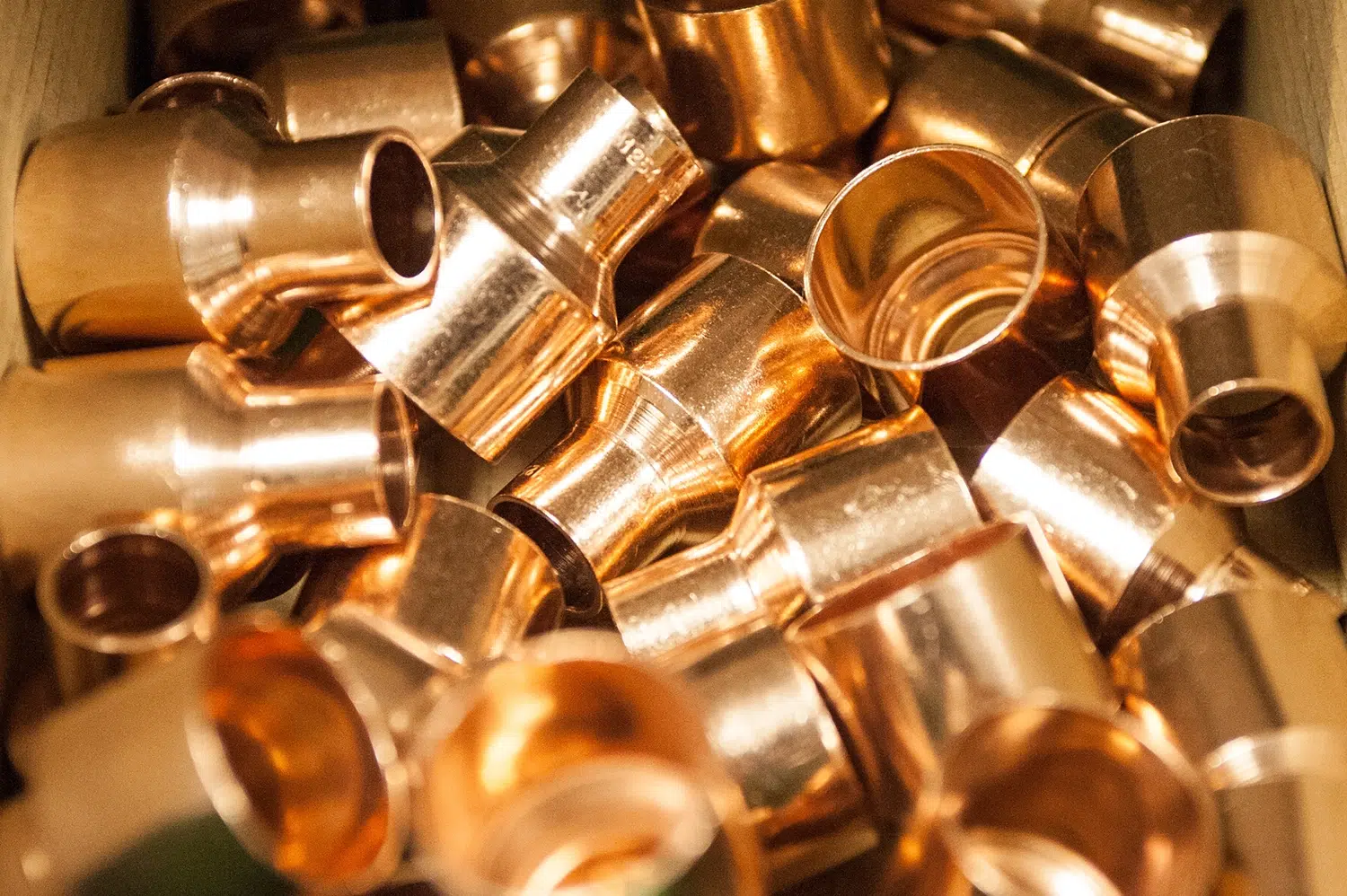
Industrial electroless copper plating is an autocatalytic chemical plating process that involves depositing a layer of metallic copper onto the surface of materials using a chemical bath, without the use of an external electric current. The deposition takes place in a chemical bath containing the reagents necessary for the reaction, following preliminary surface preparation that generally includescleaning, pickling, and activation steps, in order to make the substrate capable of initiating and sustaining the reduction reaction.
Once initiated, the reaction proceeds in an autocatalytic and uniform manner across the entire active surface, allowing for the gradual formation of a continuous, uniform copper film with a controlled thickness.
This type of process is commonly used for treating parts that require uniform metallization and precise control of the coating, particularly in demanding industrial environments.
The benefits of this chemical copper plating
A process that does not require electricity
The copper deposit is formed solelythrough a chemical reaction, directly on the surface of the activated material. This simplifies the process and eliminates the constraints associated with the electrical conductivity of the parts. The deposit depends solely on the bath parameters.
Precise thickness control
The thickness of the copper layer is primarily controlled by the immersion time and the stability of the chemical bath. This control ensures reproducible results in industrial production. Variations remain minimal when the parameters are properly regulated.
Compatibility with a wide range of materials
Chemical copper plating can be applied to a wide variety of materials, including certain non-conductive materials after activation. This makes it possible to metallize engineering plastics, composites, and ceramics. This versatility greatly expands the range of industrial applications, allowing the process to be adapted to different parts.
Uniform coating on complex parts
Chemical copper plating produces a perfectly uniform copper deposit across the entire surface. The thickness remains consistent, even in recessed areas or complex shapes. The result is an even coating across the entire geometry of the part .
The chemical copper plating process
Chemical copper plating is a process for surface treatment that takes place in several successive steps, resulting in a copper deposit formed by a chemical reaction without an electric current.
The process begins with careful preparation of the part, which typically includes degreasing to remove organic contaminants, followed by etching to remove surface oxides and activate the substrate. Depending on the nature of the material, a sensitization and activation step may be necessary to make the surface catalytically active.
The part is then immersed in a copper plating bath containing copper ions, a reducing agent, and stabilizing additives. Under these controlled temperature and pH conditions, a redox reaction occurs on the surface. The copper ions are reduced to metallic copper, forming a thin layer that is self-sustaining due to its autocatalytic nature. The deposit thus builds up gradually and uniformly until it reaches the desired thickness, after which the part is rinsed and, if necessary, transferred to other surface treatment stages.
Why choose Wipelec for electroless copper plating?
Wipelec supports you in carrying out your chemical copper plating projects, offering proven technical expertise and solutions tailored to your needs.

Learn more about electroless copper plating
Do you have questions about electroless copper plating? Find answers to the most frequently asked questions here!
What is the difference between chemical and electrolytic copper plating?
Chemical copper plating does not require an electric current, unlike electrolytic copper plating.
In the electrolytic process, deposition is driven by an electric field between an anode and a cathode.
Chemical copper plating relies solely on a reduction reaction in solution. This allows for a more uniform deposit on complex parts. Electrolytic plating can result in variations in thickness depending on the part’s geometry. Chemical copper plating is therefore better suited for hard-to-reach areas.
On the other hand, the electrolytic process allows for higher deposition rates.
The two processes can be complementary in certain industrial production lines. The choice depends on the application and the material being processed. They are not based on the same physical principle.
On which materials can chemical copper plating be applied?
Electrolytic copper plating can be applied to a wide range of materials. Metals can be treated afterappropriate surface preparation. Non-conductive materials, such as engineering plastics, can also be copper-plated after chemical activation. This step makes the surface catalytically active. Composites and certain ceramics can also be treated. Each material requires specific pretreatment to ensure the deposit adheres properly. Preparation conditions have a significant impact on the final quality. The process is therefore highly versatile but requires technical expertise. It is used in a variety of industrial settings.
Why is chemical copper plating used?
Electrolytic copper plating is used to apply a uniform copper layer to technical parts. It allows for the plating of complex geometries that are difficult to cover using other processes. It is also used as an intermediate layer in multilayer systems. The deposited copper often serves as a base for other metal coatings. The process is valued for its precision and consistency. It is suitable for parts requiring thin, controlled metallization. The electronics and mechanical industries frequently use it.
In which industries is electroless copper plating useful?
Chemical copper plating is used in many industrial sectors:
- Electronics and Printed Circuit Boards
- Precision Machinery
- Energy and Transportation
- Complex parts
Where is electroless copper plating used?
The cost depends on several factors. It includes chemicals, maintenance, and bath monitoring. The process can be cost-effective for complex parts. It sometimes eliminates the need for additional processing steps. The cost varies depending on production volume. Please feel free to contact us if you would like a customized quote.
Related surface treatments
Would you like to learn more about our other surface treatments? Find out more and explore all our solutions!