
Copper plating
What is copper plating?
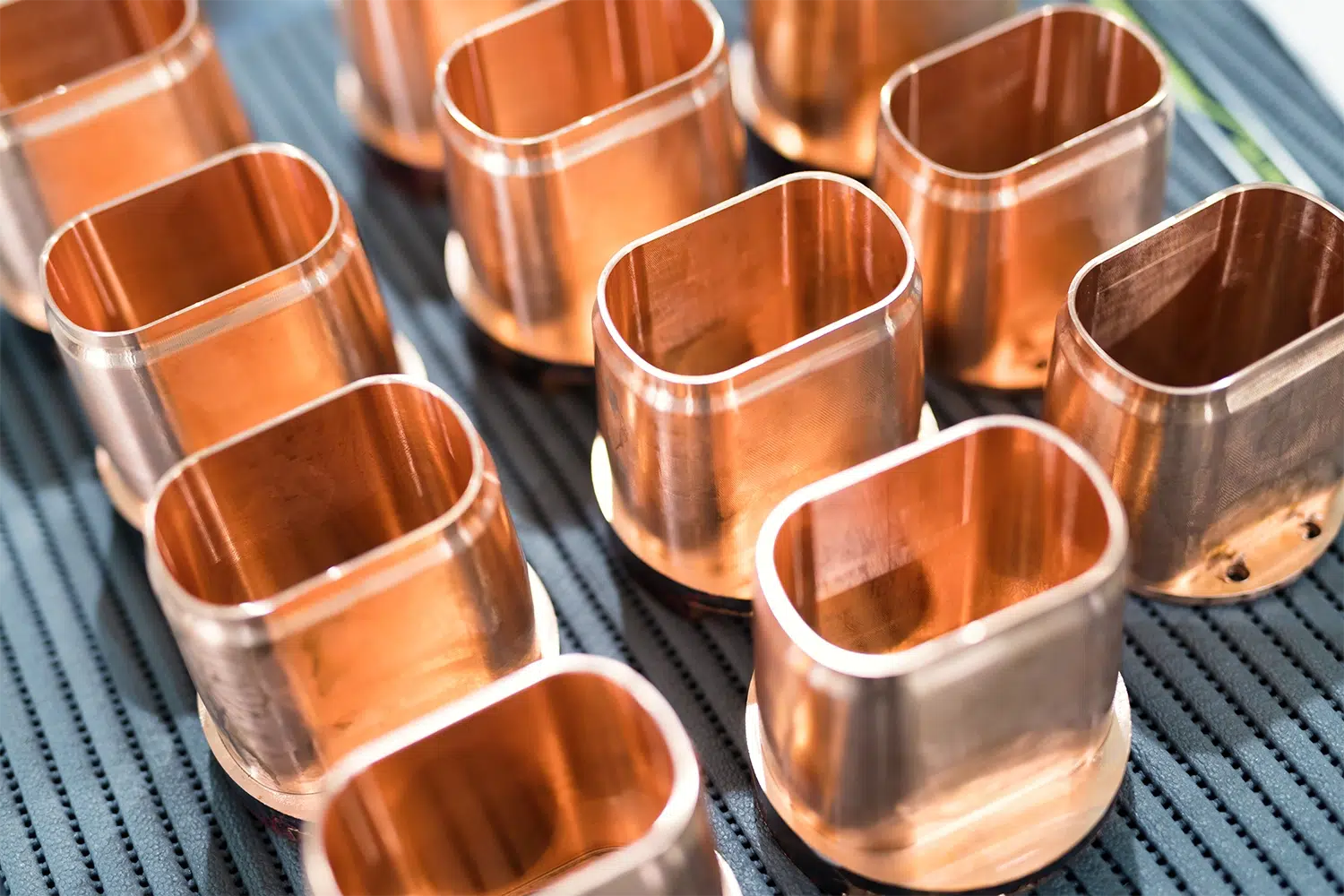
Copper plating is a surface treatment process that involves depositing a thin layer of copper onto various types of surfaces to enhance their properties. Widely used in industries such as electronics, automotive, and jewelry, it is valued as much for its technical performance as for its aesthetic appeal.
Copper plating is particularly valued for its excellent conductivity, which is essential in many electrical and electronic applications. It also provides protection against corrosion and improves the adhesion of subsequent treatments. Finally, its warm, lustrous appearance makes it an ideal solution for decorative applications, combining performance with aesthetics.
Copper plating methods
At Wipelec, we use a variety of copper plating techniques, carefully selected to meet your specific needs and the technical requirements of your project.
Electrolytic copper plating
- Improves the electrical conductivity of parts
- Protects against corrosion and oxidation
- Promotes adhesion of subsequent layers or treatments
Electrolytic copper plating
- Even coating, even on complex shapes
- Capability to process non-conductive materials
Flash copper plating
Flash plating isa very thin, rapid deposit of copper applied to a part. This technique is ideal as a bonding layer prior to further processing.
- Improves the adhesion of the following coatings
- A fast and cost-effective method
- Effectively prepares the surface for subsequent treatments
The advantages of this process
Optimal conductivity
Copper plating optimizes current flow through metal parts. Thanks to copper’s excellent conductivity, it is particularly well-suited for electrical and electronic components. This ensures reliable and long-lasting performance.
Improved traction
Copper serves as an ideal base before applying other treatments such as nickel plating or chrome plating. It improves the adhesion of subsequent layers and ensures a uniform finish. This results in a final finish that is both more durable and aesthetically pleasing.
Aesthetics and finish
Copper plating provides a warm, lustrous finish that enhances the appearance of objects. It can be used on its own or as a base coat for decorative finishes. This process is therefore also popular for visible or design-oriented applications.
Corrosion protection
By forming a protective barrier, copper limits the oxidation of metal surfaces. This extends the service life of components, even in harsh environments. This treatment also reduces maintenance requirements.
The copper plating process
The copper plating process begins with thorough surface preparation, during which the parts are cleaned and degreased to remove any impurities that could impair adhesion.
An intermediate treatment, such as etching or activation, is then performed to strengthen the bond between the substrate and the copper.
The part is then immersed in an electrolytic or chemical bath, allowing for the controlled deposition of a thin layer of copper.
Finally, thorough rinsing followed by drying—and possibly polishing— ensures a uniform, glossy, high-quality finish.
Learn more about copper plating
Do you have questions about copper plating? Find the answers to the most frequently asked questions here!
Can copper plating be applied to all materials?
Copper plating is primarily applied to metals, but thanks to electroless copper plating, it is also possible to treat certain non-conductive materials , such as plastics. However, this requires specific surface preparation to ensure proper adhesion.
Is copper plating compatible with high temperatures?
Copper is relatively resistant to moderate heat. However, at very high temperatures, it can oxidize. Its properties can therefore change depending on the thermal environment. It is often used in combination with other protective coatings.
In industrial applications, it remains stable under controlled conditions. It may lose effectiveness under extreme conditions.
Temperature also affects the coating's adhesion. Thermal stresses must be taken into account. This is not a high-temperature coating per se. It is suitable for standard industrial environments.
What quality control checks are performed after copper plating?
After copper plating, several quality control checks are performed to ensure that the process meets specifications and performs as intended.
The thickness of the deposit is measured precisely using specialized instruments, while the adhesion of the copper is tested to ensure that the coating adheres properly to the substrate. The uniformity of the surface is also inspected to verify the absence of defects or uncovered areas, and electrical tests may be performed when electrical conductivity is required.
In addition, the product is carefully inspected for any imperfections, scratches, or irregularities. These inspections are based on strict industry standards that define quality requirements.
Each batch may undergo a specific audit in accordance with customer specifications. All of these checks ensure a consistently high level of reliability in the copper plating process.
Is copper plating compatible with moving parts?
Copper plating can be applied to moving parts, but its performance depends heavily on the mechanical wear stresses to which it is subjected. In environments characterized by repeated friction, it is rarely used as a top layer, as copper is a relatively soft material that can wear down quickly when in direct contact. For this reason, it is generally incorporated into multilayer systems where it serves as an intermediate layer, notably improving the adhesion of harder coatings applied on top. Surface engineering thus leverages its properties to optimize the overall performance of treatments, combining copper plating with other deposits to meet higher mechanical and tribological requirements.
Why choose Wipelec for copper plating?
Wipelec supports you in carrying out your projects that require copper plating as a surface treatment.

Related surface treatments
Would you like to learn more about our other surface treatments? Find out more and explore all our solutions!