
Titanium Machining
Everything You Need to Know About Titanium Machining
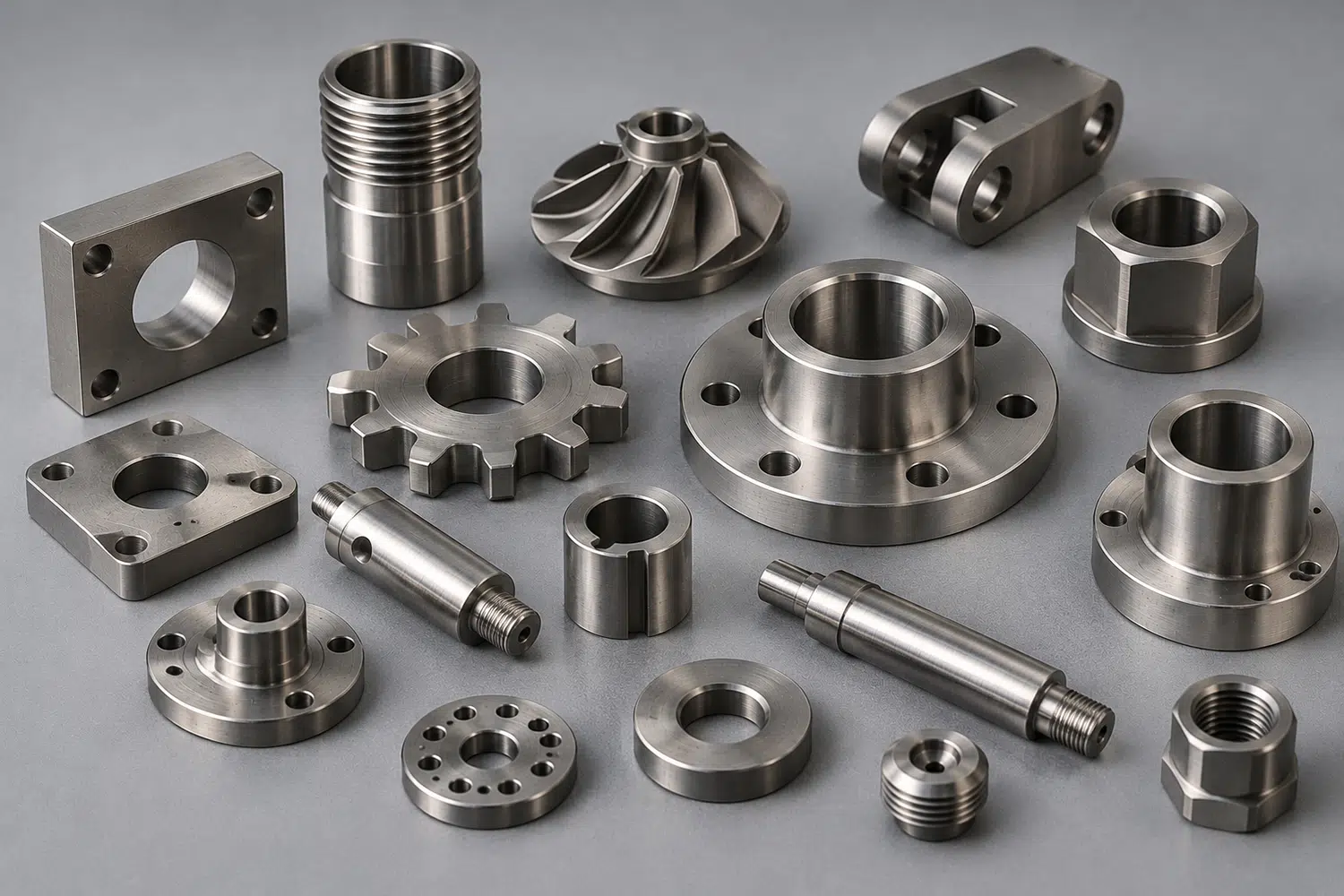
Titanium is a material used in many industrial sectors. Whether in the aerospace, medical, energy, or precision engineering sectors, it is used tomanufacture high-performance components designed for demanding environments.
Machining titanium therefore requires careful selection of tools, cutting parameters, and manufacturing strategies. Mastering these elements is essential to ensuring the precision of your parts, maintaining surface quality, and optimizing production costs.
What is titanium?
Titanium is a metal widely used in industry. It is valued for its light weight, strength, and good corrosion resistance. Although titanium occurs in large quantities in nature, its extraction and processing are complex. That is why it is generally more expensive than other metals.
There are several types of titanium, known as grades, each with its own characteristics.
The most common ones are:
- Grade 2 titanium: a nearly pure form of titanium that is highly resistant to corrosion and can be easily deformed without breaking.
- Grade 5 titanium (Ti-6Al-4V): a very strong and lightweight alloy that is widely used in industry.
- Grade 23 titanium (Ti-6Al-4V ELI): an alloy used primarily in the medical field, thanks to its high purity and excellent mechanical properties.
The choice of titanium depends on the part’s intended use, the loads it must withstand, the temperature, the environment, and the desired weight. In machining, it is therefore important to select the right grade to ensure that the part meets the required specifications and is easy to manufacture under the anticipated conditions.
Why is machining complex?
- Low thermal conductivity
- Increased tool wear
- Cutting Forces to Control
- Significant chip removal
- Surface quality to be maintained
What are the main properties of titanium?
High mechanical strength
Some titanium alloys offer high mechanical strength while maintaining a relatively low mass. This balance is particularly desirable for parts subjected to high mechanical stresses.
It enables the design of components that meet high mechanical requirements, particularly when weight reduction is a key consideration.
Excellent corrosion resistance
Titanium naturally develops a protective oxide layer that contributes to its corrosion resistance in many environments, making it an attractive choice for certain chemical equipment, marine applications, and components exposed to aggressive fluids.
However, the material's compatibility must be verified based on temperature, chemical concentration, and conditions of use.
Reliable performance in demanding environments
Depending on the specific grade, titanium can retain desirable properties under demanding thermal or mechanical conditions.
Certain alloys are used in aerospace, energy, and industrial applications that require a reliable material under specific operating conditions.
Biocompatibility: A Priority in the Medical Field
Certain grades of titanium are used to manufacture implants and medical devices because of their biocompatibility and corrosion resistance.
These applications involve specific requirements regarding surface quality, cleanliness, material traceability, and compliance with applicable specifications.
Strong skills in designing technical parts
Titanium can be machined to produce complex shapes, functional surfaces, and precision components.
However, feasibility depends on the geometry, the required tolerances, tool accessibility, and the available manufacturing resources.
Do you have a titanium machining project?
Machining titanium requires precise control over cutting conditions, tools, and the specific challenges associated with this material. At Wipelec, we work with you to assess your machining needs in order to identify a solution tailored to the requirements of your parts and your specifications.
Do you have a design that needs to be costed, a prototype that needs to be built, or parts that need to be mass-produced? Send us your request so we can discuss your project and assess its feasibility.
Everything You Need to Know About Titanium Machining
Do you have questions about titanium machining? Find the answers to the most frequently asked questions here!
What is the density of titanium?
The density of titanium is approximately 4.5 g/cm³, which is significantly lower than that of steel, whose density is generally close to 7.85 g/cm³.
This difference offers a significant advantage for applications that require lighter components without compromising high mechanical performance.
| Material | Density (approximate) |
|---|---|
| Titanium | 4.5 g/cm³ |
| Aluminum | 2.7 g/cm³ |
| Steel | 7.85 g/cm³ |
However, any comparison of materials must take into account their mechanical properties, corrosion resistance, thermal behavior, and cost.
In the aerospace industry, for example, titanium can help reduce the weight of certain structures and mechanisms while withstanding significant mechanical stresses.
For manufacturers, the decision to use titanium is therefore not based solely on its purchase price. It involves evaluating the overall cost of the part in light of its performance, service life, and the requirements of the application.
How do you choose the right titanium grade for machining?
Choosing the right shade is an important step in the success of a project.
A material that is suitable for corrosion resistance may not necessarily be the best choice for a part subjected to high mechanical stresses.
Several criteria must be taken into account:
- Mechanical constraints: strength, stiffness, and in-service stresses.
- Operating environment: humidity, corrosion, fluids, and temperature.
- Manufacturing requirements: tolerances, surface finish, and geometric complexity.
- Regulatory requirements: industry standards, traceability, and material specifications.
- The total cost: material cost, machining time, and inspection requirements.
Grade 2 is particularly valued for its corrosion resistance and ductility, while Grade 5 is often chosen for applications requiring high mechanical strength.
Other shades may be preferable depending on the project's constraints.
If in doubt, we can analyze the specifications to verify that the proposed material meets the functional requirements without incurring unjustified additional costs.
Can titanium be machined using CNC?
Yes, we can use CNC machining for titanium; in particular, CNC milling and CNC turning are commonly used to manufacture titanium components. The success of the project depends, among other things, on the rigidity of the equipment, the choice of tools, the cutting conditions, and how the workpiece is secured.
Is titanium always better than steel or aluminum?
No, titanium offers advantages in terms of mechanical strength, weight, and corrosion resistance, but its cost and machining challenges must be taken into account. The best material is the one that meets the application’s requirements at the most cost-effective price.
Why is machining titanium more expensive?
The cost may be higher than that of many common materials due to the cost of the material, machining time, tool wear, and inspection requirements. A well-designed product and an optimized manufacturing strategy can help keep these costs down.
Why is titanium difficult to machine?
Titanium is a difficult material to machine due to its mechanical and thermal properties. It is a poor heat conductor, which causes heat to concentrate at the cutting tool and accelerates its wear. It also exhibits high chemical reactivity at high temperatures, a tendency to stick to the tool, and specific requirements regarding lubrication and chip management.
In practice, machining titanium requires a suitable machine, a rigid fixture, and carefully controlled cutting parameters. Tool selection, lubrication, and machining strategy play a critical role in ensuring part accuracy and maximizing tool life. Mastering this material therefore depends as much on understanding its properties as on the ability to stabilize the manufacturing process.
Can you machine materials other than titanium?
In addition to titanium, we also machine a wide range of other materials, tailored to the requirements of each project.
In particular, we specialize in machining stainless steel—valued for its corrosion resistance and durability— aluminum— known for its light weight and ease of fabrication—and steel— chosen for its strength and mechanical properties.
These various solutions enable us to meet a wide range of requirements in terms of precision, performance, and quality, while tailoring our processes to the specific characteristics of each material.
| Material | Key Benefits | Applications |
|---|---|---|
| Titanium | Lightweight, corrosion-resistant, excellent strength-to-weight ratio | Aeronautics, Medical, Industry |
| Stainless steel | Corrosion-resistant, durable, good mechanical properties | Medical and Industrial Equipment |
| Aluminum | Lightweight, easy to machine, good corrosion resistance | Aeronautics, Automotive, and Mechanical Parts |
| Steel | Sturdy, wear-resistant, good mechanical properties | Industrial Machinery and Mechanical Parts |
Do you have a question about titanium machining? Need a quote? Feel free to contact us.
Our Contact Information
Would you like to learn more about our titanium machining solutions? Please feel free to contact us by phone or through our contact form.