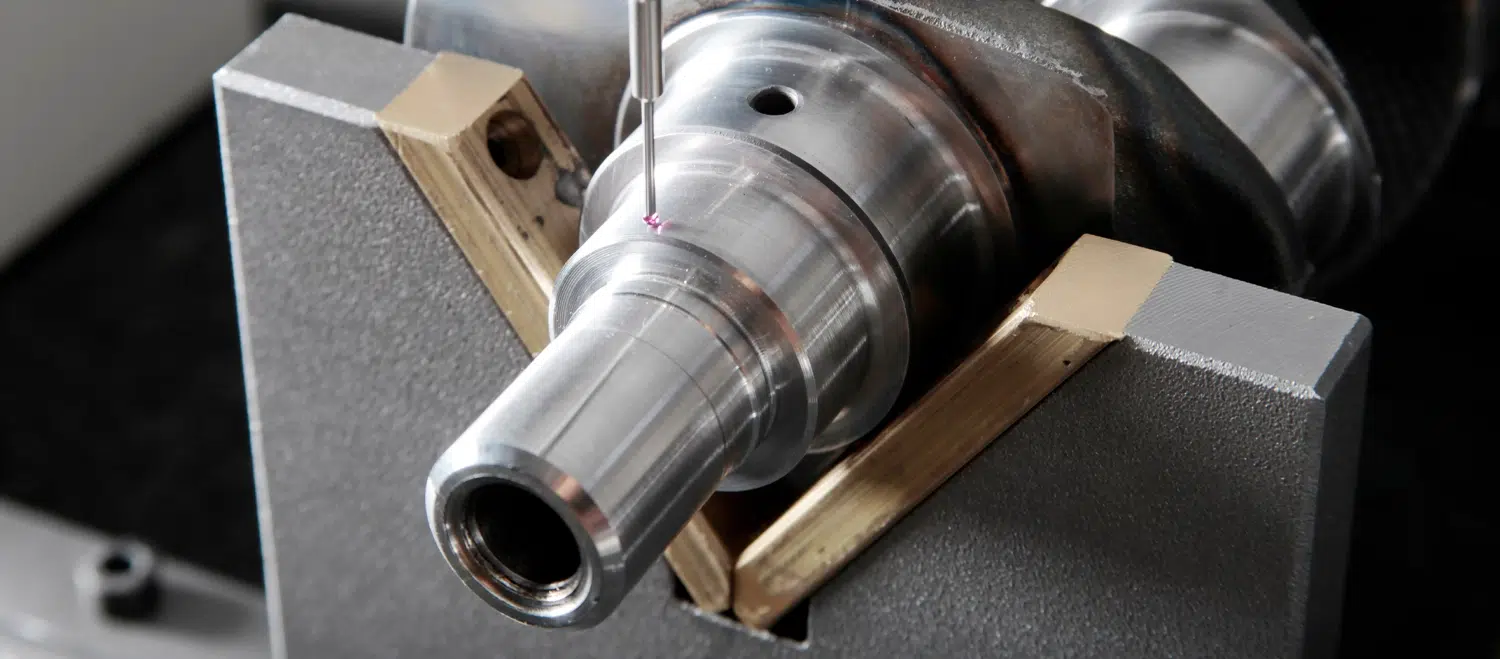
Precision machining is an essential manufacturing technique in industry. Used in many sectors, such as the automotive and aerospace industries, it enables the production of parts with complex shapes and high precision. Thanks to technological advances, CNC machines have significantly improved the performance of this process. But what exactly is CNC machining, and how does this technology work?
What is CNC machining?
CNC (Computer Numerical Control) machining refers to a mechanical manufacturing process in which machine tools are controlled by a computer program. This technology allows parts to be manufactured by removing material from a blank, typically made of metal or plastic, until the desired shape is achieved.
Unlike conventional machining, which requires more manual intervention, CNC machining automates the movements of the tools and the machine’s axes. The program precisely defines the toolpaths, cutting speeds, and the various operations to be performed.
This automation ensures excellent repeatability, high dimensional accuracy, and better control over production. It is suitable for both prototype manufacturing and the production of small, medium, or large batches.
The various materials that can be machined using a CNC machine
One of the major advantages of CNC machining is its compatibility with a wide range of materials. The choice depends on the desired mechanical properties, the part’s operating conditions, and manufacturing constraints.
- Metals: aluminum , steel, titanium, brass, pure iron, etc.
- Engineering plastics: POM , polyamide, polyethylene, polycarbonate, etc.
How has CNC machining evolved over time?
Before we learn more about CNC machining, let’s talk about the history of computer-numerical-control machining. This type of process is linked to the development of industry and computer technology.
In the mid-20th century, the growing needs of industries such as aerospace spurred the search for methods to manufacture complex parts with greater precision and consistency. The first computer-numerically controlled (CNC) machines gradually made it possible to control tool movements based on programmed instructions.
As industrial computing has evolved, control systems have become more powerful. Machines have become more precise and faster, and are now better able to perform a sequence of operations without constant manual intervention.
How does CNC machining work?
The CNC machining process consists of several complementary steps, from the design of the part to the inspection of the finished product.
1. The Design of the Piece
The first step is to design the part to be manufactured using computer-aided design (CAD) software. The digital model represents the necessary dimensions, shapes, and geometric characteristics.
2. Programming the machine
The model is then processed using computer-aided manufacturing (CAM) software. This software is used to define the machining operations and generate a program—typically consisting of G and M codes—that the CNC machine can interpret.
3. Preparing the machine
The operator loads the raw material, secures the workpiece, and sets up the cutting tools. The operator also sets the origin points, cutting parameters, and other settings necessary for the operation to proceed smoothly.
4. Machining the part
The machine automatically runs the program. Depending on the process used, the cutting tool or workpiece performs precise movements to gradually remove material. The operator monitors the process and intervenes if necessary.
5. Quality Control
Once machining is complete, the part is inspected to verify that it conforms to the drawings and the specified tolerances. Conventional measuring instruments or more advanced metrology equipment may be used.
What is the difference between CNC machining and traditional machining?
The main difference between these two methods is how the machine tool is controlled.
In traditional machining, the operator manually sets and controls the movements required for manufacturing. This method remains suitable for certain simple operations, repairs, adjustments, or the production of single parts.
In CNC machining, the movements are defined in a digital program that the machine executes automatically. The operator, however, continues to play a key role in job setup, tool adjustment, selection of cutting parameters, and inspection of parts.
Computer numerical control (CNC) allows for:
- Greater consistency among the parts produced.
- Greater control over machining paths.
- The ability to create complex geometries.
- A reduction in certain manual tasks.
- Better suited for mass production.
However, the choice between the two methods depends on the project. CNC is not always the most cost-effective solution for a very simple operation or a single part.
Need a CNC machining expert?
Trust Wipelec to support you in your industrial projects. Contact our team to discuss your needs and find solutions tailored to your technical requirements.
What are the main types of CNC machining?
There are several types of CNC machining processes. Each is designed to meet specific needs depending on the part’s shape, the material used, and the required level of precision.
CNC Milling
CNC milling involves removing material using a rotating tool equipped with multiple cutting edges. It is used to create flat surfaces, grooves, pockets, contours, and complex geometries.
This technique is used to manufacture mechanical supports, housings, structural parts, and many industrial components.
The number of axes on a machine affects its manufacturing capabilities. Three-axis machines are suitable for many common parts, while multi-axis machines make it easier to machine more complex shapes.
CNC Turning
CNC turning is primarily used to manufacture parts of revolution (such as a shaft, a bushing, or a screw). The workpiece rotates around its axis while a tool gradually removes material.
Turning is particularly useful when workpieces have successive diameters, grooves, threads, or cylindrical surfaces that require high precision.
CNC Drilling and Tapping
Drilling is used to create holes at specific locations. Tapping involves creating an internal thread designed to accommodate a screw or other threaded fastener.
These operations are often integrated into a milling or turning cycle to minimize repositioning and improve manufacturing efficiency.
3-Axis, 4-Axis, and 5-Axis CNC Machining
The number of axes on a machine determines the possible movements of the tool and the workpiece.
- 3-axis machining: Themachine operates in three main directions, typically X, Y, and Z. This configuration is suitable for many parts whose surfaces are accessible from a given orientation.
- 4-axis machining: An additional rotational axis allows the workpiece or tool to be oriented so that certain operations can be performed on multiple faces.
- 5-axis machining: Two additional rotary axes allow for the combination of multiple orientations. This configuration facilitates the production of complex geometries and can reduce the number of repositioning operations required.
The choice of configuration depends on the complexity of the part, the required tolerances, access to the surfaces, and the manufacturing cost.
Frequently Asked Questions About CNC Machining
What is the difference between CNC and 3D printing?
CNC machining is generally a subtractive process. In fact,material is removed from a block to achieve the final shape.
3D printing, on the other hand , is an additive manufacturing process. The part is built up gradually by adding material. The choice depends on the geometry, the material, the quality requirements, and the production volume.
Is CNC machining suitable for small production runs?
Yes, it is suitable for prototypes, one-off parts, and small production runs, particularly when precision or geometric complexity warrants it. However, the cost of programming and setup must be taken into account.
How much precision can be achieved with CNC machining?
Accuracy depends on the type of machine, the material, the geometry, the tooling, the manufacturing conditions, and the inspection methods. There is no single value that applies to all parts. Tolerances must be defined according to the project requirements and confirmed with the manufacturer.
What materials can be machined using CNC?
CNC machining allows for the processing of various materials depending on the technical requirements and needs of each project. Among the most commonly machined materials are stainless steel, valued for its corrosion resistance; aluminum, known for its light weight and ease of machining; and steel, suitable for many applications requiring mechanical strength and durability.
In conclusion
CNC machining is now an indispensable technology in the mechanical engineering industry. Thanks to computer numerical control, it enables the production of complex parts with high precision and excellent repeatability, while meeting the requirements of many industrial sectors. However, the selection of materials, machining techniques, and manufacturing parameters remains essential to ensuring part quality and optimizing production costs.
In this context, we support you in your industrial projects by applying our expertise to meet your technical needs.Do you have a project or would you like to learn more about the solutions we offer? Contact our team to discuss your needs and find out how we can support you.